
Unprecedented water rationing to begin in WA’s Yakima Basin
Seattle Times, Oct. 2, 2025 at 11:02 am by Conrad Swanson
Drought conditions east of the Cascade crest are so dire that state officials plan to cut off water for farmers, ranchers and more, something they’ve never done before.
Reservoirs in the Yakima River Basin are expected to run out of water early next week, officials with the Washington Department of Ecology said in a release. To conserve what little water remains for fish and senior water rights holders in the 6,100-square-mile basin, the state will halt surface water use, including water drawn from rivers, streams and reservoirs, on Monday through the end of the month.
Click Here for full article.
Columbia Basin irrigation group opposes state drought insurance program proposal
William Albert, Apple Valley News Now, Oct 27, 2025
The Brief
• Washington Department of Ecology developed the Interruptible Drought Insurance Program to help farmers who lose water access during dry years
• Columbia-Snake River Irrigators Association opposes the proposal, citing lack of early input and unclear operational details
• The irrigation group believes the state may withdraw the proposal after recent productive meetings with Ecology officials
Click Here for the complete article.
Roza Irrigation District shuts off early due to drought
QUESTEN INGHRAM-Yakima Herald-Republic Sept. 28, 2025
The Roza Irrigation District stopped delivering water to its users Wednesday after exhausting its supply this year.
The district, which supplies water to 72,000 acres of fruit trees and other crops in the lower Yakima Valley, is subject to proration during water-short years.
“Our bucket ran empty,” said Dave Rollinger, the watermaster of the Roza Irrigation District.
Click Here for the story.
Water shutoffs happening earlier than usual for some Yakima Basin irrigators
QUESTEN INGHRAM-Yakima Herald-Republic Sept. 5, 2025
Water shutoffs are happening earlier than usual for some irrigators in the Yakima River Basin.
Reservoir levels are at the lowest seen since 1971. Non-senior water rights holders in the Yakima basin are expected to receive 40% of their allotment this year, an estimate that has held since August’s meeting, according to a release from the Bureau of Reclamation. Senior water rights holders will continue to receive full allotment.
Click Here for the story.
Yakima Basin faces worst drought conditions since 1971 record-keeping began
by John Kennedy O’ConnorThu, August 7th 2025 at 3:32 PM
Updated Fri, August 8th 2025 at 3:25 PM
Trump cuts halt local overnight weather forecasts for Eastern WA, OR
Annette Cary Tri-City Herald
May 18, 2025
The National Weather Service office providing forecasts and hazardous weather warnings for much of Central and Eastern Washington, including the Yakima Valley, will no longer be staffed at night because of Trump administration job cuts and a federal hiring freeze.
The office in Pendleton, Ore., serves one of the largest areas outside of Alaska. Its Washington state service area includes Benton, Franklin, Walla Walla, Yakima, Columbia, Kittitas and Klickitat counties. It also covers 11 counties in Eastern Oregon, including Umatilla and Morrow counties.
Yakima County burn ban takes effect June 1
Yakima Herald, May 20, 2025
A countywide burn ban for unincorporated Yakima County will be in effect from June 1 to Sept. 1.

Yakima Basin water supply update (Dept. of Ecology)
As we turn the corner on winter, we look ahead to warmer days and longer daylight hours. But as much as we cherish that springtime feeling, many in the Yakima Basin are hoping for cold precipitation in the weeks ahead. Cold temperatures are key to building the snowpack that is critical for the basin’s water supply.
Yakima Basin drought
The Yakima Basin had back-to-back droughts in 2023 and 2024. Heading into irrigation season, we are starting to get a better idea of what conditions may look like for the rest of the year and how it will impact the basin. We’re likely facing a third consecutive year of drought, which hasn’t happened since 1992-94.
As of March 6, 2025, the five basin reservoirs had only 38% of what’s typical at this time of year. That’s the third lowest since 1971. The basin will need far above average snowpack to recover, which is unlikely with a rapidly closing window for big storms to provide water. While the remainder of March and April are expected to be cooler and wetter than average, it probably won’t be enough to make up the difference.
Check out the Yakima County information about this season’s drought possibilities here.
Federal official visits Rimrock Lake to announce $400K boost for fish passage project
- PHIL FEROLITO Yakima Herald-Republic
- Oct 4, 2022
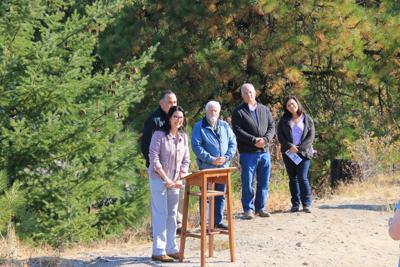
Shannon Estenoz, assistant secretary of Fish and Wildlife and Parks, announces $400,000 in funding from the U.S. Department of Interior on Friday, Sept. 30, 2022, during a visit to the site of a fish passage project on the South Fork Tieton River near Rimrock Reservoir.Photo courtesy of Yakima County
A plan to help anadromous fish return to the South Fork Tieton River near Rimrock Reservoir during the fall recently received a $400,000 boost from the U.S. Department of Interior. Click Here for complete article.
Article: “Grant awards were made by a state board for salmon recovery. Nearly $76 million was awarded including funds for the Yakima River Basin.”
The above article about this award can be found in the September 29, 2022 Northern Kittitas County Tribune.
Rising temperatures will shift timing of water availability, amplifying vulnerabilities in Columbia River Basin over next 20 years
NEWS PROVIDED BYWashington State Department of Ecology
Department of Ecology News Release – Aug. 1, 2022COLUMBIA RIVER BASIN –
Anticipated future shifts in water supply and water demands will combine to create potential vulnerabilities related to water availability across many areas of eastern Washington, according to a new report from the Washington Department of Ecology, Washington State University, and the State of Washington Water Research Center. Click Here for the full article.
RECORD SOCKEYE RUN DIDN’T REACH YAKIMA
Columbia River salmon, steelhead runs largely positive for 2022; Yakima Basin concerns remain
- Luke Thompson Yakima Herald-Republic
- Sep 21, 2022

A record-breaking sockeye run highlighted an encouraging year for salmon and steelhead returning to the Columbia with thousands more still expected to arrive this fall.
Those gains didn’t necessarily translate to the Yakima Basin, where Yakama Nation Fisheries biologist Andrew Matala said only 464 sockeye passed the upper river counting station, down from close to 4,400 in 2020.
Click Here for complete story.
UNPRECEDENTED FUNDSAID YAKIMA BASIN PROJECTS
Unprecedented salmon recovery funds to benefit Yakima Basin projects
- Luke Thompson Yakima Herald-Republic
- Sep 28, 2022

Five projects in Yakima County and several more throughout the Yakima Basin are set to benefit from nearly $76 million in grants to fund projects across the state, the Washington Recreation and Conservation Office announced Monday.
The Legislature doubled the funds for the Salmon Recovery Board and the Yakima Basin Fish and Wildlife Recovery Board said more than $4 million will go to Yakima Basin organizations in Yakima and Kittitas counties.
Click Here for complete Story
Which States Produce the Most Renewable Energy?
Last Updated: October 28, 2021
Read more at: https://commodity.com/blog/states-renewable-energy/
Despite snow, rain, Pacific Northwest faces drought
April 29, 2021 Yakima Herald Republic-AP
MOUNT VERNON, Wash. (AP) — Despite a healthy amount of snowfall in the North Cascades over the winter and some recent rain, the Pacific Northwest slid last week into the “abnormally dry” drought category.
“We’ve had some unseasonably dry weather. … We’ve seen an intensification of dryness since February, and particularly in the past 60 days,” said Kelsey Jencso of the Montana Climate Office. “It is shaping up to be a pretty dry spring.”
Click Here for Complete Story.
Tracking sockeye: Research on fish could lead to new projects in Yakima River basin
- LUKE THOMPSON Yakima Herald-Republic
- Jul 6, 2020 Updated Jul 10, 2020
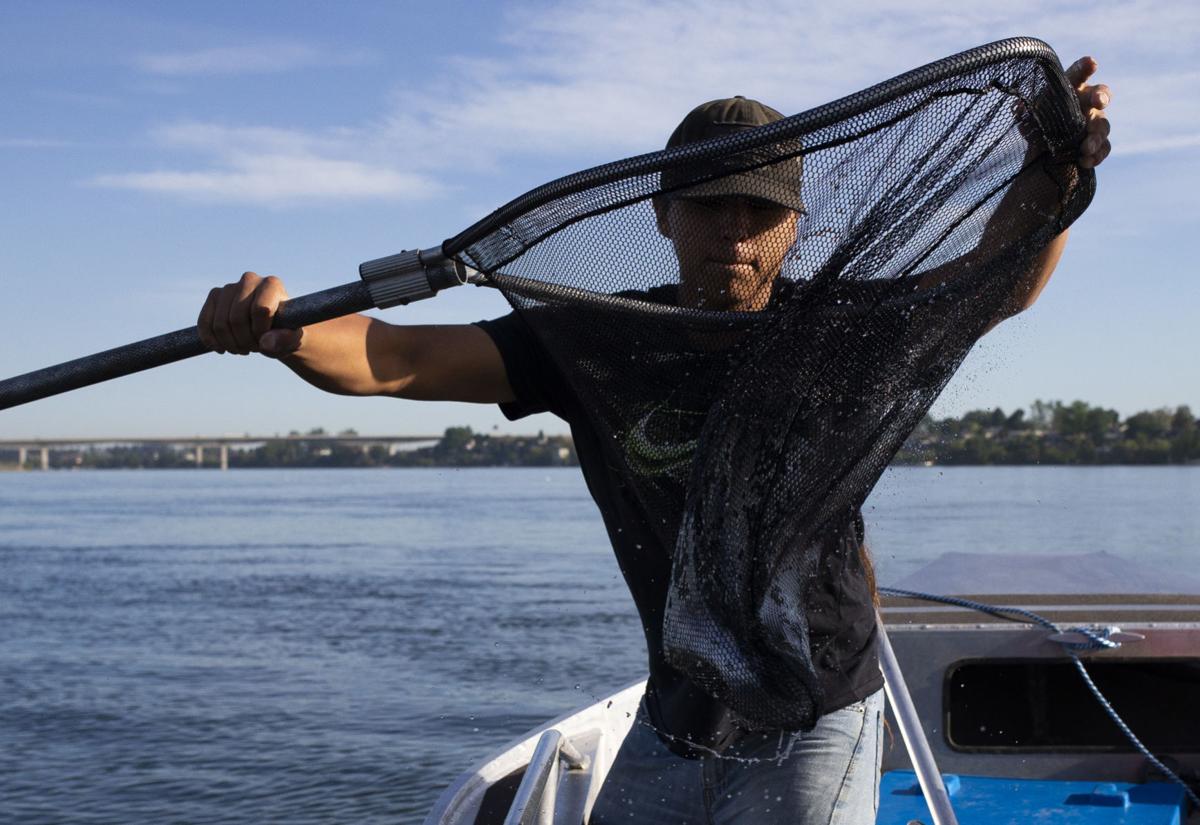
Washington state aims to regulate water temperature at federal dams, wading into controversy
- Lynda V. Mapes
Seattle Times - May 26, 2020 Updated May 26, 2020
Click on Link Below:
Some farmers plan to tap drought relief wells if surface water supply runs short
- PHIL FEROLITO Yakima Herald-Republic July 1, 2019
See link for story
https://www.yakimaherald.com/news/local/some-farmers-plan-to-tap-drought-relief-wells-if-surface/article_d872d90d-046b-5fe1-b493-8cb8c6487599.html
Drought could be with us for a while, officials say. Here’s how it is affecting crops, fish and the fire season.
- DONALD W. MEYERS Yakima Herald-Republic
- Jun 30, 2019
While drought conditions are not as dire as in 2015 when the Roza Irrigation District turned off its system for three weeks to conserve water, experts say this year is shaping up to be a dry one.
“Given the condition of where we were at the start of the season, we’re not in bad shape, but we’re heavily prorated,” said Doug Call, river operator for the U.S. Bureau of Reclamation in Terrace Heights. “There’s always a chance that the weather might give us a break.”
But state officials and growers are bracing for a hot, dry summer that could affect crop yields as well as contribute to an extensive wildfire season.
See
https://www.yakimaherald.com/news/local/drought-could-be-with-us-for-a-while-officials-say/article_1c63ff63-d5ce-5309-b61c-1d874a741382.html for complete story.
Cle Elum dam fish project uses innovative, first-of-its-kind technology
- LEX TALAMO Yakima Herald-Republic
- Jun 29, 2019
Use link to read story:
https://www.yakimaherald.com/news/local/cle-elum-dam-fish-project-uses-innovative-first-of-its/article_020b4d4b-0c14-593b-bbf2-1fd05bc83f6e.html
Bureau of Reclamation approves further study of Kachess floating pumping plant
- LEX TALAMO Yakima Herald-Republic
- May 12, 2019
YBSA Position December 2018
YBSA ask: To pressure DOE and USBR to build more storage!! YBIP Started 2009!
YBSA Purpose: To secure an adequate water supply for Ag., Fish, and Munis for next 100 years.
YBIP: We support the Yakima Basin Integrated Plan, but more water and money are needed to make it work. We support Yakima County’s position that the YBIP Workgroup has not made enough progress on storage (Goal is 500 kac-ft).
Water Volume Needed: We believe Ag needs around 300 kac-ft of storage, and fish flows we estimated between 200 kac-ft and 800 kac-ft, based on historical flows, as the fish are short of water in good years and bad years. High volumes are needed to mitigate the Thermal Barrier and reactivate side channel functionality for salmon restoration. Therefore, if any of the above in-basin elements fail, the plan cannot achieve its goals.
Climate Change: Will further exacerbate water supplies. Every new report from UW Climatology emphasizes the future risk to both fish and Ag water in our Basin, and currently we don’t have enough for both! The reports show the east sides of the Cascades to be at highest risk in the PNW, but not the Columbia headwaters.
Kachess Dead Storage: (200 kac-ft) Is vital to attempt, we doubt they can overcome local Nimby forces and National Bull Trout issues. USBR decision (ROD) is expected January 2019. We believe lawsuits will be filed the next day, and we don’t know who will pay, nor how reliable the supply is. Est. cost is $200-$400M.
Bumping Enlargement: (160 kac-ft) This will motivate national environmental opposition which, just like the 1986 attempt, aborted storage construction. The 208 USBR storage study dropped BLE, too much opposition.
Wymer: (160 kac-ft) Least political resistance of 3 Yakima Basin options, was rejected in 2008 for being as costly as Black Rock per ac-ft of storage. It offers the potential of being supplies from the Columbia River, albeit through the Yakima Firing Center, with very high pumping costs.
Thermal Barrier: The Thermal Barrier in lower Yakima River is the biggest threat to salmon restoration. Temps above 71℉ kill salmon. We believe that significant winter/spring flows need to be stored in Flood Plains, then return to mainstem to mitigate lethal temperatures from the Columbia to Sunnyside Dam in July and August for returning Sockeye. We also believe Climate change will further exacerbate this problem.
Money: It will take a combination of Junior Irrigator funding. Taxpayer funds, both State and Federal, and additional funds must be garnered form additional benefits. Recreation and Power sectors benefits have not been assessed, let alone maximized.
Pumped Storage: Significant benefits can be found by storing water and energy to balance the grid from San Diego to Vancouver B.C. Currently there is an imbalance on the order of 2k megawatts. As western states shift to more intermittent renewables, this number will grow. We believe the Columbia River is on of the best sites on the West Coast for this purpose. We, YCDA and TRI-DEC will host a workshop to discuss needs, benefits, and barriers of such a project Fall 2019. YBIP has yet to evaluate the possibilities for pumped storage.
Water planning in the Yakima Basin, in one form or another, has been almost continuous since Chief Kamiakin started watering his garden next to Ahtanum Creek in 1852. With the creation of the Bureau of Reclamation in 1902, design and construction of irrigation reservoirs became a reality, and in 30 years five major reservoirs were completed, with a combined storage capacity of just over 1 million acre/feet of water.
Today, eighty-five years after the reservoir system was completed, it is painfully evident that the current water supply and infrastructure are entirely inadequate to meet the challenges of maintaining several billion dollars of annual agricultural production and restoring large runs of salmon and steelhead, particularly in light of a changing climate that is producing less snow, lower stream-flows and higher air and water temperatures.
The severity of the challenge is illustrated by the drought of 2015, which cost the Yakima Basin several hundred million dollars in reduced or damaged agricultural production. In addition, due to lethal water temperatures in the Yakima and Columbia Rivers, most of the migrating adult sockeye salmon returning to the Columbia Basin were killed.
Unfortunately, the current water planning effort (Yakima Basin Integrated Plan), initiated in 2009, fails to take into account either the challenges of providing water for agriculture and salmon in the face of a changing climate, or the opportunities afforded by our geographic proximity to the Columbia River, and our ability to move electrical power in and out of the basin. Most critically, the current planning effort does not recognize the pressing regional need for electrical power load balancing.
Instead of looking forward to the next 100 years, the current water planning effort, led by the Bureau of Reclamation and Washington Department of Ecology, is reminiscent of water planning in the 1950s. The only water supply being considered is that produced within the Yakima Basin. This supply will never meet the needs of both agriculture and salmon in the basin.
Vision and leadership are essential components of water planning in the Yakima Basin. The men who conceived the water storage reservoirs clearly understood they were creating a water supply system for the next 100 years. And they provided the leadership to make it happen.
Today, the Yakima Basin faces unprecedented challenges with respect to future water supplies for agriculture and salmon. But there are also unprecedented opportunities.
What is needed is the vision and leadership to provide water for the Yakima Basin in 2100, only one human lifetime away. Nothing less will meet the challenges of tomorrow and the needs of agriculture and salmon in this basin.
Water planning in the Yakima Basin stands at a crossroads. We can plan by looking in the rear view mirror. Or we can, like those visionaries of the second half of the nineteenth century, plan for the next 100 years. But one thing is clear when it comes to water planning in the Yakima Basin: No Vision, No Leadership, No Water.
Bob Tuck lives in Selah
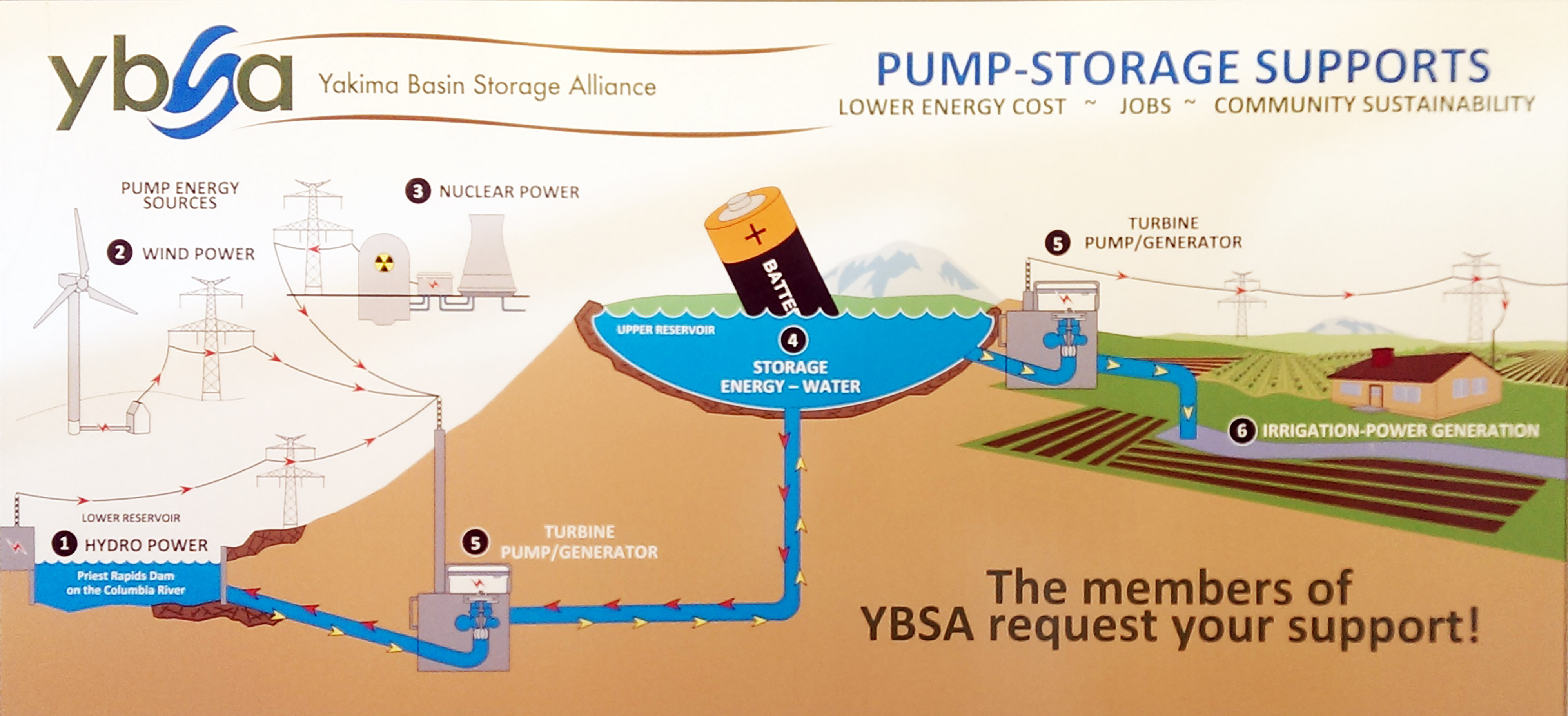
Yakima Basin Storage Alliance
To launch a grass-root campaign designed to educate and raise the awareness about irrigated agriculture and its relationship with Washington State communities and economies.
To provide evidenced demonstrating why the Yakima Basin desperately needs increased storage.
To illustrate that the Yakima Basin’s economies are in jeopardy if we do not increase water storage for the Yakima Basin.
To become a resource and catalysts for storage activism, both locally and statewide. To actively investigate, identify, assess, and promote storage solutions while presenting a unified, informed alliance to engage opposition.
To become the umbrella organization for Yakima Basin storage supporters, forging a foundation for political and social reform that will result in increased storage to benefit irrigated agriculture, instream flows, salmon recovery, Yakima River ecology, and Yakima Basin communities.
Yakima River Basin
The Yakima River flows 215 miles from the outlet of Keechelus Lake in the central Washington Cascades southeasterly to the Columbia River, draining an area of 6,155 square miles. The Yakima River Basin is one of the most intensively irrigated areas in the United States. Population in the Yakima River Basin was about 238,000 in 1990.Increasing demands for water for municipal, fisheries, agricultural, industrial, and recreational uses will affect the ground-water resources of the basin. A better understanding of the ground-water flow system and its relation to rivers and streams is needed to effectively manage the basin’s water resources.
In cooperation with the U.S. Bureau of Reclamation, the Washington Department of Ecology, and the Yakama Indian Nation, the USGS is studying the ground-water system in the Yakima River Basin and how it interacts with rivers and streams in the basin. The study includes data collection, mapping of hydrogeologic units and ground-water levels, and a computer numerical model to bring together all the information.
$300 million to dam up a dry canyon? It could make sense for the Mid-Columbia
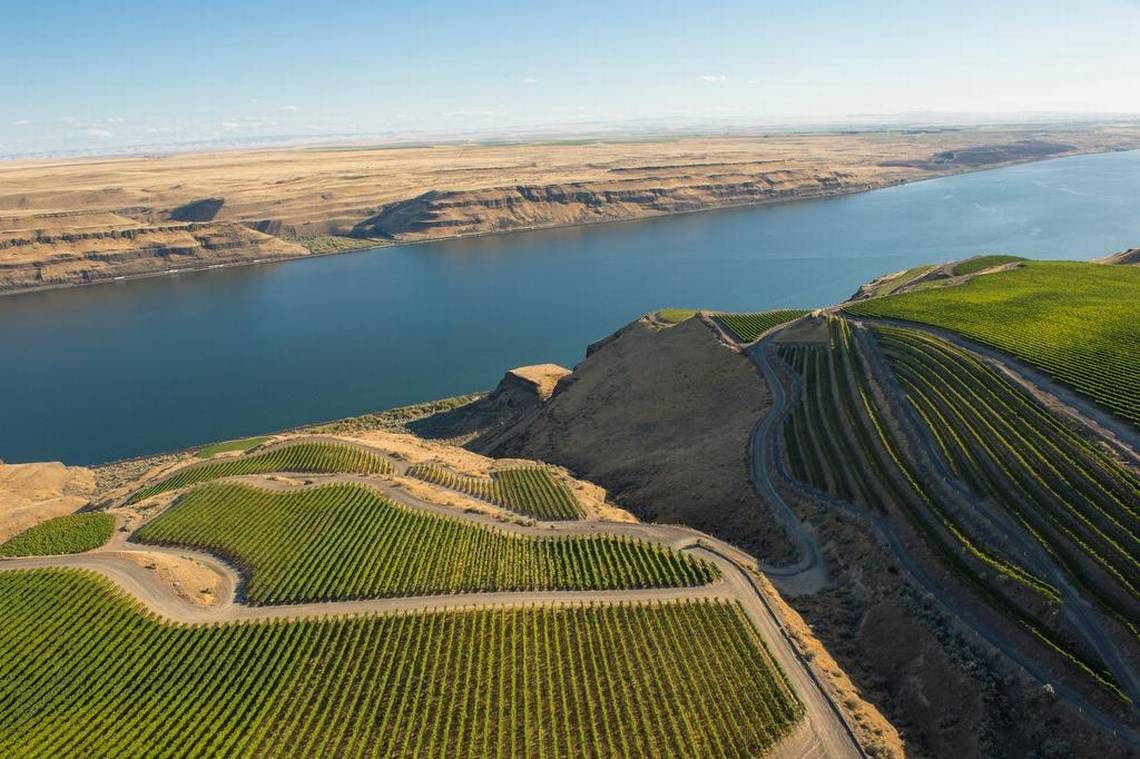
Andrea Johnson / Washington State Wine
A bone-dry canyon south of Kennewick could hold the key to planting more wine grapes and other high value crops along the Columbia River.
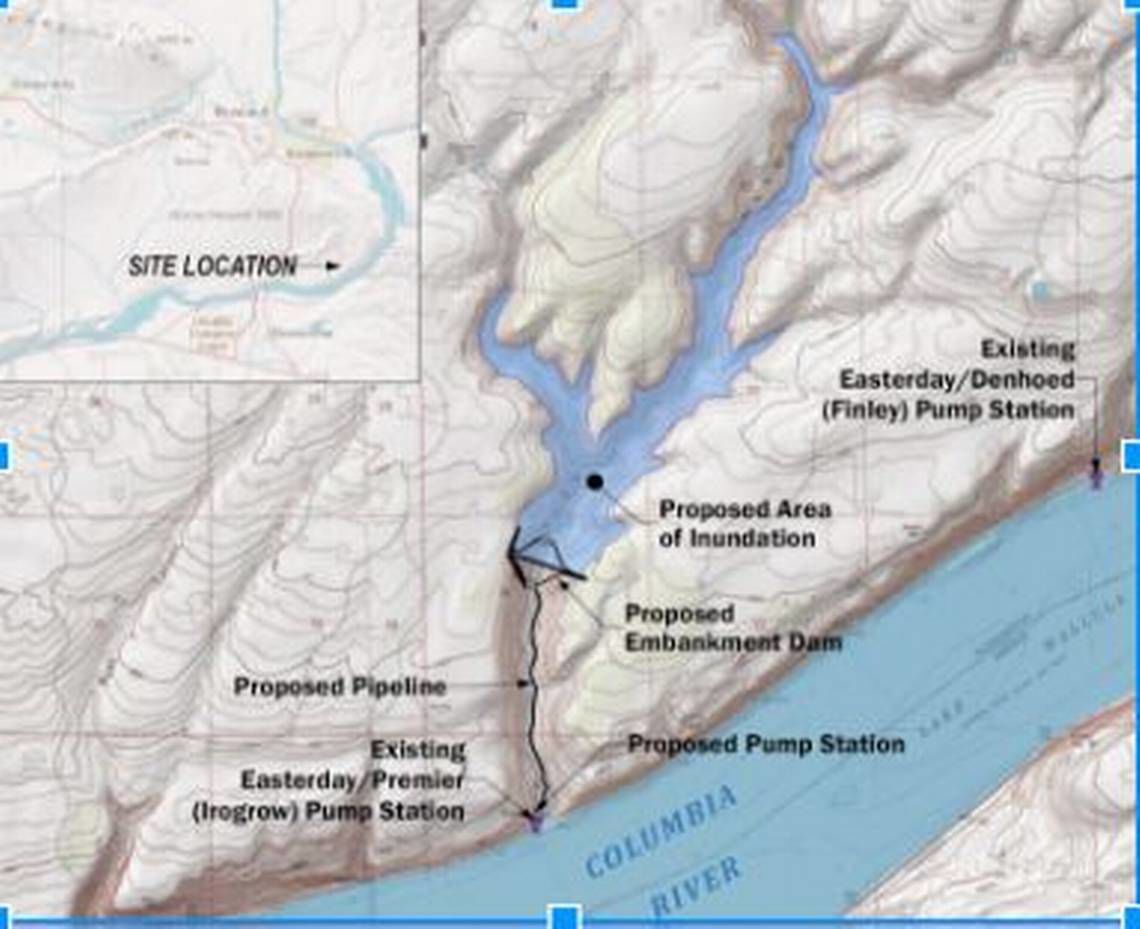
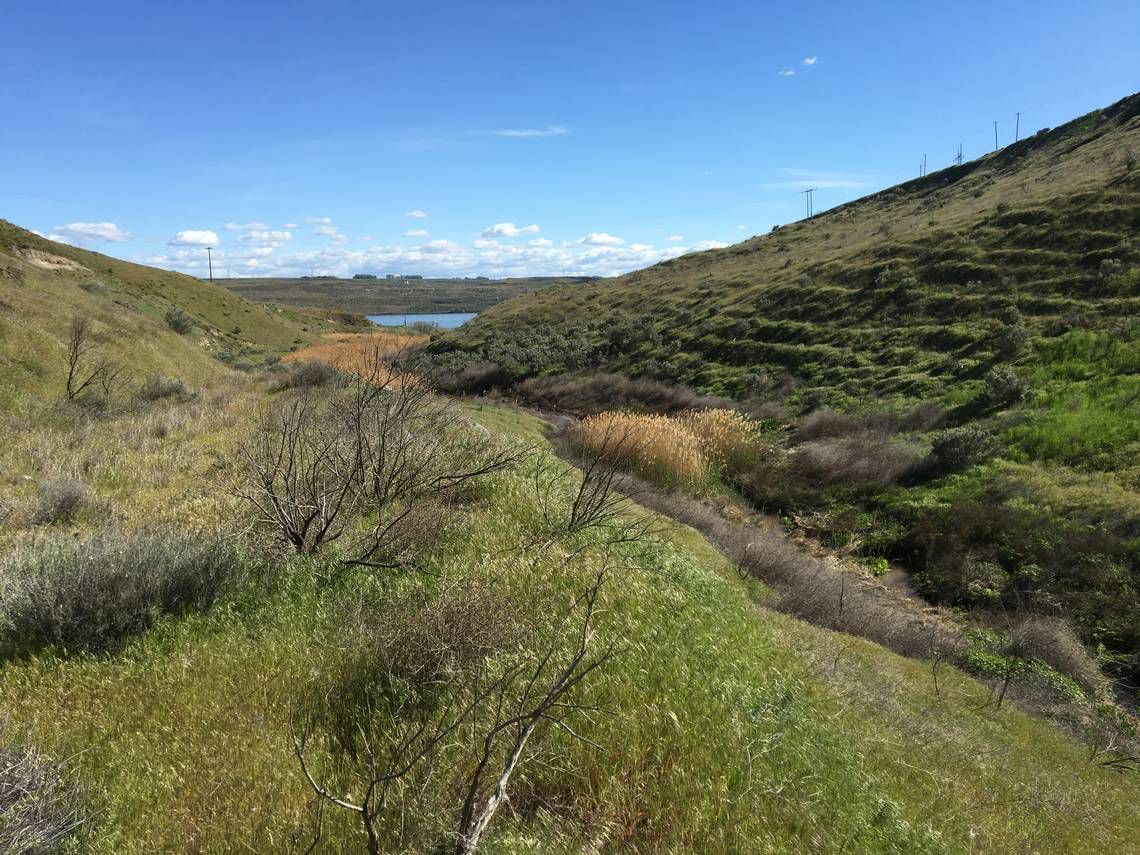
Switzler Canyon, an ancient waterway above McNary Dam, could be dammed and turned into a reservoir.
With a capacity of 44,000 acre-feet — the water needed to produce 16.4 million gallons of wine — the reservoir would allow officials to issue new water rights and bolster supplies during dry times.
If built, Switzler Canyon Reservoir would bank water in the spring, when it’s plentiful, and release it in the summer, when it’s not.
Officials have been kicking the idea around for more than a decade.
Now, the Washington Department of Ecology, working with Benton and Klickitat counties, is about to launch a two-year, $1 million environmental impact study.
The public can shape the review by identifying economic and environmental issues now, before the process gets started.
Switzler Reservoir in theory would offer farmers more reliable access to water from the pools behind the John Day and McNary dams.
The reservoir would release water as needed to ensure the Columbia experienced no net loss of stream flow.
Farmland in southern Benton County and eastern Klickitat would benefit the most.
“It’s for new water rights in the Horse Heavens,” said Joye Redfield-Wilder, spokeswoman for the department of ecology.
Not the region’s first reservoir
A study is no guarantee Switzler Canyon will ever become a reservoir.
Funding the project will be difficult. A 2012 study by Aspect Consulting said the cost could be more than $300 million, adjusted for inflation.
At 44,000 acre-feet, the Switzler Canyon Reservoir is far smaller than Black Rock Dam, a 1.7 million acre-foot behemoth proposed for the Yakima Basin some 20 years ago.
Black Rock would have been filled with water pumped from the Columbia when water ran high and power rates were low.
Conceived to bank water for droughts, when junior water rights holders see their water curtailed, Black Rock would have been one of the largest dams of its kind.
Though advocates continue to push the project, its multi-billion dollar price tag has kept it from advancing.
A former Benton County official who worked on Black Rock said it is effectively dead.
Pros and cons
Darryl Olsen, executive director of the Kennewick-based Columbia-Snake River Irrigators Association, put the odds of Switzler Reservoir being built at “zero.”
The association’s board opposed Switzler last year, calling it financially unsound. Olsen said the board will review it again, but he doubts its position will change.
Irrigators feel the $1 million the state allocated to the EIS would be better spent on conservation measures in the Roza Irrigation District.
That would yield near-term water savings, Olsen said.
“We want to support things that are going to get built and that are going to deliver water,” he said, calling Switzler a “hydraulic fiction.”
Adam Fyall, Benton County’s sustainable development manager, said the idea is worth exploring.
As drought years arrive with greater frequency, it’s important to address summertime shortages that harm agriculture.
Storage is a critical piece of the picture. Switzler is the best of the options studied over the past decade.
“This is a mitigation reservoir to assist in drought years,” he said. “We are in a dry area that is always water stressed, with or without climate change.”
Fyall prefers to call Switzler a “concept” rather than “proposal.”
To move forward, it will need a champion, possibly a new utility district to develop, maintain and operate it.
It would have to offer water at a price irrigators are willing to pay, but it won’t be low-cost. High-value crops such as wine grapes could make sense.
Wheat would not.
A source of funds has not been identified, but could include a mix of state and federal dollars and revenue bonds backed by user fees.
The project
From above, Switzler Canyon has the jagged shape of a two-point antler, with one long prong and one shorter one.
The canyon narrows as it reaches the Columbia. It’s mouth is near a pump station operated by Easterday Farms, on the Washington side, east of Plymouth and across the water from Oregon’s Hat Rock State Park.
A 320-foot earthen dam would block the canyon at the the channel.
As with Black Rock, Columbia River water would be pumped via an 83-inch pipe to the reservoir when the river is high and power is cheap.
The reservoir is not intended to serve boaters or recreation since the property is privately owned by Easterday and its neighbors.
The owners have given preliminary approval to evaluate the concept, said Fyall.
It would affect habitat and attract water-oriented species to the area. There is no current plan to equip the dam with power generators.
Get involved: Officials will discuss the Switzler project from 4-7 p.m., Sept. 19 at the Klickitat County PUD Building and from 4-7 p.m., Sept. 20. at the Benton County Fairgrounds in Kennewick. Written comments can be submitted to David McClure, director of the Klickitat County Department of Natural Resources and Development, 127 W. Court St., Goldendale, WA 98620. The comment deadline is Oct. 15. Past studies and documents are posted at bit.ly/SwitzlerCanyonReservoir
Reclamation issues draft programmatic investigation report for Yakima Basin tributaries
Media Contact: Edna Rey-Vizgirdas, (208) 378-5212, ereyvizgirdas@usbr.gov
For Release: August 01, 2018
YAKIMA, Wash. – The Bureau of Reclamation has completed a draft Yakima Basinwide Tributaries Programmatic Investigation Report. The report describes potential projects to enhance water supplies, improve habitat conditions, and benefit federally listed fish species in tributaries throughout the Yakima River basin.
The study was completed under the Yakima River Basin Water Enhancement Project (YRBWEP) in coordination with the Yakama Nation, State of Washington, National Marine Fisheries Service, and Yakima Basin irrigators. Enhancement measures such as fish passage, water conservation, floodplain reconnection, and habitat restoration may be considered for various tributaries in the basin, based on identified needs. Any future project implementation will involve opportunities for public involvement as well as participation by the Yakama Nation, State of Washington, water users, and other stakeholders.
To obtain copies of the draft report, contact Jason Romine at jason_romine@fws.gov.
The document is available online at: https://www.usbr.gov/pn/programs/yrbwep/phase2/tribhab/index.html.
Written comments should be addressed to Jason Romine, U.S. Fish and Wildlife YRBWEP representative, Bureau of Reclamation, 1917 Marsh Road, Yakima, Wash., 98901-2058. Comments will be accepted until August 31, 2018.
Background: https://www.usbr.gov/pn/programs/yrbwep/.
State officials say it would cost millions to keep the Naches fish hatchery open. The hatchery manager say that’s “bogus.”
Record Lamprey Return A Cultural Win For Native Tribes
By Courtney Flatt June 18, 2018 Northwest Public Broadcasting
Below is a video of Lamprey Harvest